COMMENTARY
Setting the Story Straight: Party Turnout and Voters of Color
By Karthick Ramakrishnan
November 24, 2026
As the 2026 midterm elections delivered a record number of Democrats to Congress this century, news headlines pointed to a sweeping demographic realignment. Interactive analyses from The New York Times and accompanying commentary highlighted dramatic leftward margin swings across racial groups compared to the 2024 presidential race. How accurate are these assessments?
Comparing raw vote margins between a presidential election and a midterm election, and calling this gap a “shift,” is a common fallacy in political analysis that treats two very different electorates as if the exact same group of people simply changed their minds. To find the real narrative, we need to dig deeper into the data.

A deeper examination reveals a more complicated story. Latino, AAPI, and Black voters were indeed more likely to switch from Trump in 2024 to Democrats in 2026. The much bigger story, however, had nothing to do with vote switching. Differential party turnout, driven both by Democratic enthusiasm and Republican dissatisfaction, played a much bigger role in the historic “blue tsunami” of 2026.
This distinction, between vote conversion and differential turnout, is consequential for politics as well as policy. First, it reaffirms the conventional wisdom that the enthusiasm and turnout of partisan voters are far more important to midterm elections than voter conversion through appeals to swing voters. It also means, however, that we should be cautious about interpreting the election results as a permanent shift in American voting behavior. The Republican base was unenthusiastic this year, just as Democratic base voters were unenthusiastic in 2014. By 2030, however, Republican turnout might come roaring back, particularly if Democrats control all representative branches of the federal government.
Breaking Down Election Data
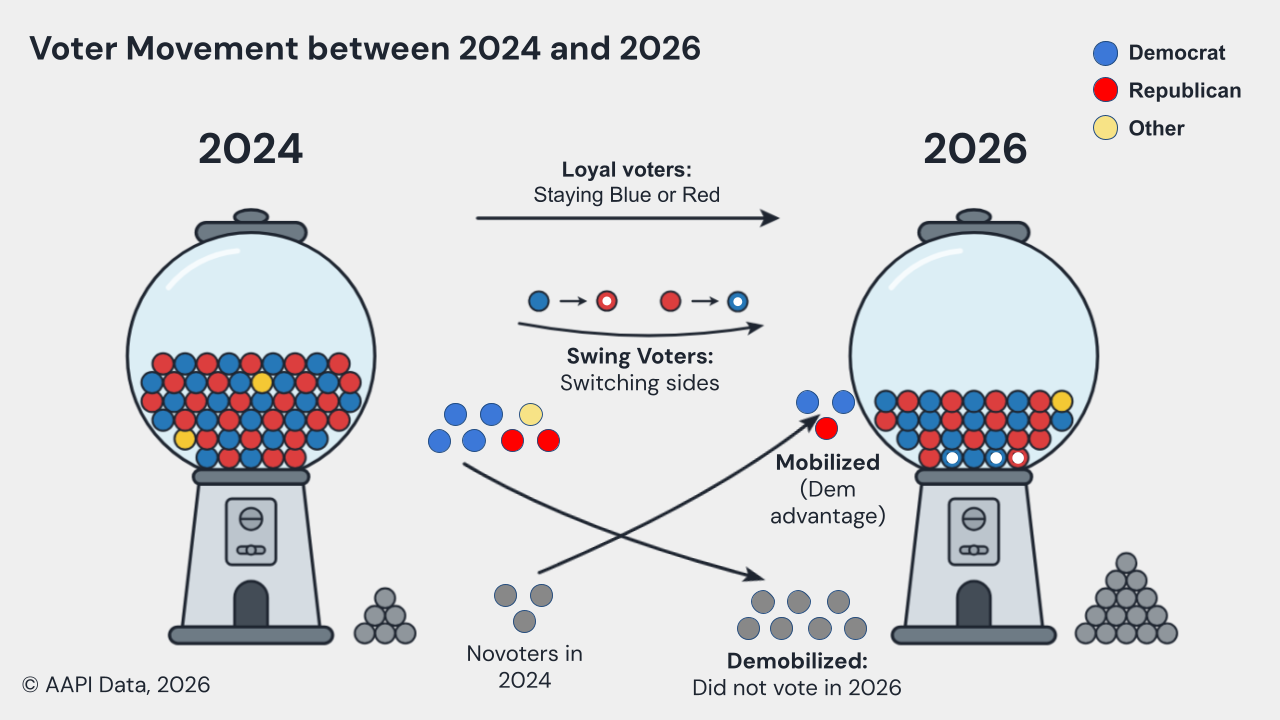
Our analysis of survey data from the Civic Health & Elections Project at NORC finds that who stayed home had a much larger impact on election results than who switched parties. Swing voters, those who switched party vote between 2024 and 2026, accounted for only about 4% of eligible voters. The share of Demobilized Voters (those who voted in 2024 voters but sat out in 2026) was about five times larger, accounting for nearly 20% of all 2026 eligible voters. Trump voters dropped out at dramatically higher rates than Harris voters across every racial group, and at 36% vs. 26% overall. Additionally, Newly Mobilized Voters (those who did not vote in 2024 but voted in 2026), leaned heavily Democratic—76% of newly mobilized AAPI voters voted for Democrats. In short, the blue wave can be attributed to Republicans staying home and Democrats doing an impressive job energizing new voters, rather than a large shift of swing voters.
To see how voters moved between 2024 and 2026, picture every eligible citizen as a gumball. People who voted sit inside a glass gumball machine, colored blue, red or yellow by the party they chose. People who didn’t vote sit in a tray outside, colored grey. Between the two elections, each gumball did one of five things: stayed inside with the same color (Loyalists), stayed inside but changed color (Swing Voters), rolled in from the tray (Mobilized), rolled out into the tray (Demobilized), or stayed in the tray both times (Inactive). Once you separate the gumballs that changed color from the ones that came in or went out, the story of 2026 is clear: far more voters entered or left the machine than switched colors, and that held for every racial group. AAPI voters switched parties at the highest rate of any group, but even among them, people who stayed home or newly turned out far outnumbered those who changed sides, despite headlines suggesting big swings.
Getting The Story Right
Comparing presidential and midterm vote margins without accounting for turnout composition is like comparing apples to oranges. Presidential elections draw a big, broad turnout while midterm electorates are smaller, older, and heavily shaped by a variety of factors such as the economy, voter mobilization efforts, and current events. Given the unpopularity of the war in Iran as well as the cost of living crisis, we might extrapolate that many Republican voters were unmotivated to turnout while Democrats were able to use this unpopularity to mobilize both new voters and existing dissatisfied Democrat voters.
The election results are not a surefire sign of a strong or permanent leftward shift in the American electorate. Voters who sat out 2026 could very well return in large numbers in 2028 or 2030. Instead of misreading the midterm results as a lasting shift in American politics, we should instead advocate for continued investments that energize and mobilize communities of color. And, as always, we should ensure that good data continue to improve media narratives, policy insights, and public understanding about AAPI communities.
To dig deeper into the voter turnout data, see our in-depth analysis here.
—
Karthick Ramakrishnan is the founder and executive director of AAPI Data.